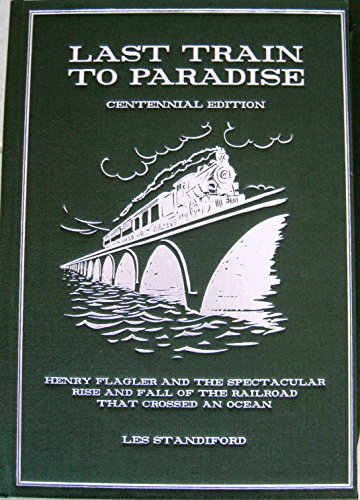
Are you looking for place to read full E-Books without downloading? Here you can read THE LAST TRAIN TO PARADISE Henry Flagler and the Spectacular Rise and Fall of the Railroad That Changed an Ocean. You can also read and download new and old full E-Books. Enjoy and relax Reading full THE LAST TRAIN TO PARADISE Henry Flagler and the Spectacular Rise and Fall of the Railroad That Changed an Ocean Books online. . CLICK HERE TO DOWNLOAD THIS BOOK FOR FREE
An oversized, limited commemorative edition of acclaimed South Florida author Les Standiford’s gripping true account of the extraordinary construction and spectacular demise of the Key West extension of Henry Flagler’s Florida East Coast Railway, originally published in 2002 and now in its 20th printing. This edition, commemorating the completion of the Over-Sea Railroad, January 22, 1912, includes a linen cloth cover, special heavy stock, silver foil stamping, a double gatefold, a hand-tipped map, and 150 new and vintage photographs and illustrations. Curators and historians at the Library of Congress, the Monroe County Library in Key West, and at the Flagler Museum in Palm Beach assisted Creative Director Petra Mason with image sourcing, as did staff at The Cooper-Hewitt Museum, New York. Many of the images in this edition have never been published before. A Books & Books Press production in association with Motherland Miami and The Henry Morrison Flagler Museum, Palm Beach, Florida. 328 pages10 ½ x 8 ½ 150 illustrations HC ISBN 978-0-9839378-0-7.00 (Author)In Last Train to Paradise novelist Les Standiford has written a lively, felicitous account of the building of the Florida East Coast Railway, which, for a little over two decades, connected mainland Florida with Key West. Henry Morrison Flagler, John D. Rockefeller's Standard Oil partner and, in many eyes, the true genius behind that company, embarked on the project in 1905 when he was 74 years old. The railroad, which crossed more than 150 miles of open sea, was an engineering feat nearly equal in scale and difficulty to the digging of the Panama Canal. Standiford's narrative skillfully blends tales of construction perils (not the least of which were escadrilles of mosquitoes) with brief, illuminating travelogues and natural histories, pocket descriptions of life in early 20th-century Florida, and a truly gripping description of an epic standoff between Mother Nature, in the form of a monstrous hurricane, and a stalled, 160-ton steam locomotive. With nary a single missed note, this fascinating tale is popular history at its best. --H. O'Billovich
